
Interview with Dr. Arlene Hiss
BY: MORIAH LEE ASCH
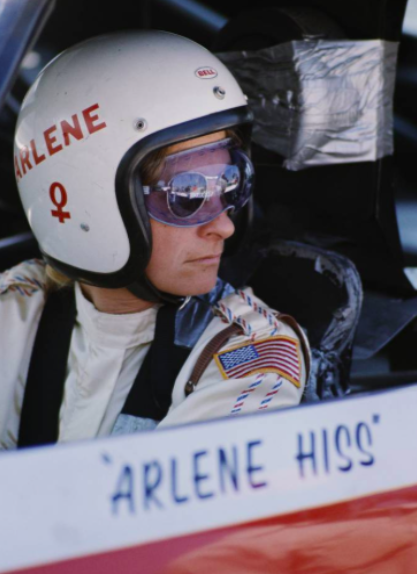
Dr. Arlene Hiss
The first woman ever granted a competitive racing license by the United States Auto Club (USAC). The first woman to start an IndyCar race in 1976. The first woman ever allowed in Gasoline Alley.
In this interview Dr. Hiss discusses her career as the first female IndyCar driver and her storied life following her experience on the raceway.
This interview was edited for length and clarity.
MLA: Feel free to introduce yourself by giving us an overview of who you are—things you’ve overcome, your work, passions—basically anything you’d like the world to know about you. Who is Arlene Hiss?
Dr. Hiss: Well how many hours do you have? [laughs] That’s the hardest question because I’ve done so many different things.
I’m Arlene Hiss. My ex-husband, who is now deceased, was an IndyCar driver and I met him at the race track. I was amateur racing at that time, and so was he, and he ended up going to Indianapolis and became Rookie of the Year. After that, I was asked to drive an IndyCar.
I drove the IndyCar at The Phoenix 150 [the Phoenix International Raceway] in 1976. I finished the race, and there was a lot of pushback from the male drivers because I was the first. And a lot of those comments are still online, you know, “what was I doing out there?” “I should be home making cakes in the kitchen, or having babies” or some stupid thing like that. But for the most part people were fine. Even today I’ll run into somebody who’s a younger person and has read about me. And of course now Danica Patrick is the latest, so there have been many women after me, and my experience helped open up the door for them.
Let’s see, what else did I do? I went to undergrad, went for my Master’s, and then I received my PhD in 1992 in Leadership and Human Behavior. And so since then I have been subbing regularly for about 20 years and teaching at Colorado State University. I teach all the “touchy-feely” things: organizational leadership, human behavior, communications, you know, all that stuff.
I also built my own house myself back in 1988. I’m still in it. I’m done with building things, though. I’m focusing on animals now: my two pigs, two chickens, two goats, and three dogs.
MLA: That’s my favorite fun fact about you. You have a whole farm back in your corner lot!
Dr. Hiss: Yep, that’s it! Arlene’s Animal Farm [laughs].
MLA: Can you give us an overview of your time as a race car driver? I’m wondering how your career began, how it all came to be, what your life looked like back then.
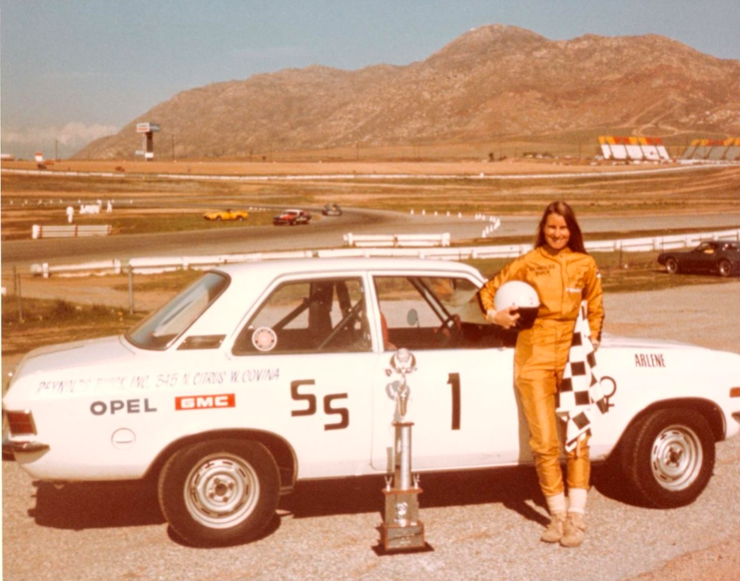
Dr. Hiss: I started amateur racing (road racing), and that was back when I lived in Connecticut. That’s where I met my husband, and then we were both racing and I was doing all the East coast racing circuits as an amateur. I won the championship three years in a row in my class in Connecticut and New Jersey. And of course the guys were always mad about that, I was certainly a target. There weren’t too many women back then—there were maybe one or two after me.
From those championship wins I was asked to drive the IndyCar. And from there I drove Nascar at the Ontario Motor Speedway which no longer exists [laughs]—half the race courses that I drove on no longer exist. But I drove the IndyCar in The Phoenix 150. I was the first woman to drive an IndyCar.
MLA: I also read you were the first woman to be granted a competition license.
Dr. Hiss: Yep, that’s right.
MLA: What got you into driving in the first place?
Dr. Hiss: Well, I was dating my ex-husband at the time, and I went to watch him at the race track and I thought to myself, “Wow, this is pretty cool.” So I started racing in parking lots to start, and then I went to the racetrack—I think it was Thompson Raceway or Limerock Raceway in Connecticut—but then I got so hooked on it. I decided, “Well, I have to get myself a car that I can race.” And I got to enter the class that my car was in with the Sports Car Club of America, that’s who it was, the SCCA. So then one thing led to another and I just started doing all the racing I could.
Then I got married and we moved to California, and my ex-husband—my late husband—he drove for Roger Penske, and so I met Roger Penske and all the big guns. And I was racing at the time of the Unsers, Bobby Unser and his brother Al Unser, and A.J. Foyt—all the big names of that era.
Dr. Arlene Hiss
MLA: In prepping for this interview I was reading up on your Wikipedia page about your historical accomplishments; you were the first woman to start an IndyCar race, you won a few California club championships, you were named the “Most Outstanding Woman Driver” by the Sports Car Racing Enterprises for Women, and you were also the first woman granted a competition license by the United States Auto Club—how did those accomplishments feel at the time?
Dr. Hiss: First of all I just want to say that I was not the one to write my Wikipedia page! I didn’t do it, someone else did [laughs]. Some of it’s not accurate, but I didn’t write it so what can I do.
Yeah, I stopped reading anything that was printed about me years ago. It got old. When I read something that I knew wasn’t true, it was difficult. I’m a private person, and it was all enough to make me irritated. It was something I wanted to put to rest. Being the first in anything is difficult. It’s just not easy.
But I still, to this day, get requests for autographs. People send me pictures and ask me to sign it. It’s dwindled down over the years, but people have collections of some of the “old timers”—I’d be considered an Old Timer, let’s just say that [laughs].
MLA: Well you seem young at heart, Arlene, that much is true.
Dr. Hiss: Yeah, some of the students that I teach recognize me. They say, “I heard you were a racecar driver!” “You drove in Nascar?!” [laughs] They all know Nascar. But when I was racing, most of it was USAC, United States Auto Club. USAC doesn’t exist anymore, now people know Nascar, but both organizations oversaw the same types of cars.
MLA: How did your family and friends react when you pursued this career? Were your loved ones supportive?
Dr. Hiss: Oh my mom and dad hated it. They wanted nothing to do with it. I mean, they were afraid for me. I did it anyway. But they just didn’t want me to get hurt and all that kind of stuff. And my sister never even watched the race I was in. It was televised and she wouldn’t watch it. She didn’t watch it. She wanted nothing to do with my racing.
MLA: That’s heartbreaking to hear.
Dr. Hiss: I had no family support.
MLA: Did anyone support you in the space? Who was the support system that you had, if any?
Dr. Hiss: Hmmm…[chuckles] I mean, my ex-husband, he supported me. But that was a long time ago. Things were different back then.
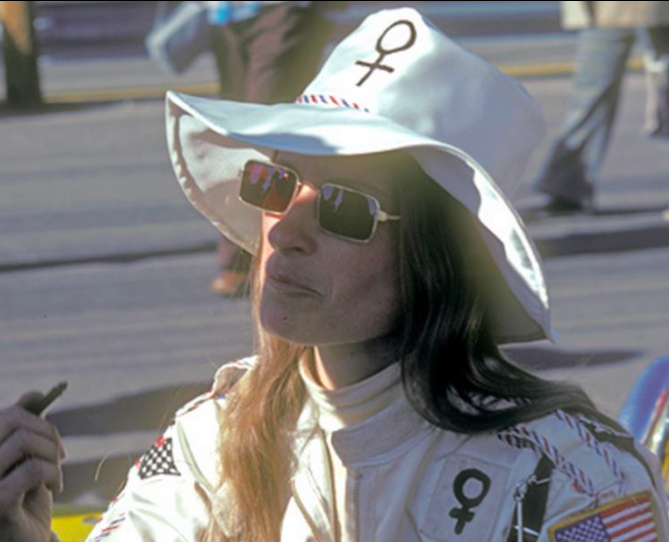
MLA: Society at the time was obviously so divided by gender, in terms of social life and careers. Were men in the league dismissive of you as a female driver? How did the males react to your presence?
Dr. Hiss: Yeah, the men mostly avoided me, but some of them became friends. I became friends with Bobby Unser, and a couple others like A.J. Foyt.
But I’ll give you a funny story I’ll never forget. During my racing years I took my car and drove up to Northern California to a race. I pulled in and I asked someone who was in my class, “What’s a good time I should aim for [in this race]?” And he gave me an estimate of what he thought a good time would be for the circuit. And he said, “But you’ll probably turn a lot slower” than the time he initially mentioned. To make a long story short: I won the race! And when I was driving out I had this big huge trophy sitting in the passenger’s seat, and out of the corner of my eye I see all of the guys I had just raced against giving me the old evil eye, because this was their track! They were there all the time, that was their home track! And this “female” drove on up from Southern California and beat the pants off ‘em. No one congratulated me, they just gave me a dirty look. That’s the way it was back then.
MLA: Wow, you had to have a spine of steel.
Dr. Hiss: Oh yeah, in everything I’ve done. Like when I was building my house back in the ‘80’s, somebody made the comment, “She shouldn’t be building a house, this woman shouldn’t be building a house. She should be cooking!” Well, I can’t cook, I can’t sew, but I can build my own house. And a house that’s very unusual, because it’s a dome. But you know, I never think about those comments until I do interviews like this [laughs].
MLA: Since your career in racing you’ve gone on to launch your own recording studio, and you also built your own house as a single woman which you mentioned. I’m wondering which of your professional or personal projects you found to be the most difficult in accomplishing. What were the hardships, and how did you overcome them?
Dr. Hiss: All of them! When I started with racing I just had to ignore all of the bad comments and all of the bad press and all the men who thought I shouldn’t be there. And then when I built my house, the same thing. In fact, I was just getting ready to pour the slab for the house, which means it was time to put the rough plumbing under the slab. And I had hired a plumber to come in and help me, but as soon as he saw what I was building, he got back in his car, turned around and drove out. So I had to do it all myself. I still hate working with plumbing to this day. But I did everything myself.
MLA: My last question for you is a little more personal. I’m wondering over the course of your life so far, what is the main thing you’ve learned about yourself, or the thing you’ve come to appreciate about yourself the most.
Dr. Hiss: Well, I appreciate that I'm 84 years old and still going strong. The only thing I’ve had to do so far is get a knee replacement, but I can still walk and run, it doesn’t even phase me. I mean, don’t get me wrong I have other minor health issues. My body might be breaking down, but I’m not letting it break me down. I still walk my dogs and animals quite a bit, and get on ladders. I just appreciate that I'm still healthy, and I think the key is to not stop. You gotta just keep moving, just keep going. You got to stay active. I still get on my roof, and get up on ladders to work. When anyone hears that I’m still getting up on my roof and my ladder they always go crazy, they say, “What are you doing on the roof?!”
MLA: Well, you just don’t stop! You’ve been defying stereotypes from your young life and even into your present. You just keep going.
MLA: I don’t have another question for you, but I do have something to tell you which is: on behalf of all the young women who are going to be reading this article, I just want to thank you for the things you did to pave the way for my generation. I think your generation of women really did break down so many barriers for those of us who came after you. And we, us young women, can now look back at the history of what you women had to face, and all the discrimination you had to endure back in those times.
Dr. Hiss: Well thank you. Oh the discrimination was just awful. You actually reminded me of a story—my ex-husband, his name was Mike Hiss and he’s all over the internet. But at the time when he was racing at Indy, women were not even allowed in Gasoline Alley. So he’d be in there working on the car with his guys, and I’d have to be standing outside the fence watching. Well—I changed that.
MLA: You did?!
Dr. Hiss: Yes. I was the first woman to be allowed in Gasoline Alley. And from then on women were allowed in the pits, they were allowed to stand outside next to the cars before a race, and I was the first one allowed.
MLA: That’s incredible, that really is incredible. And that’s why I’m thanking you, because it was women like you who paved the way for the equality that we younger women get to experience now, and I’m just very grateful.
Dr. Hiss: I’ve never thought about it like that. Thank you for saying that.